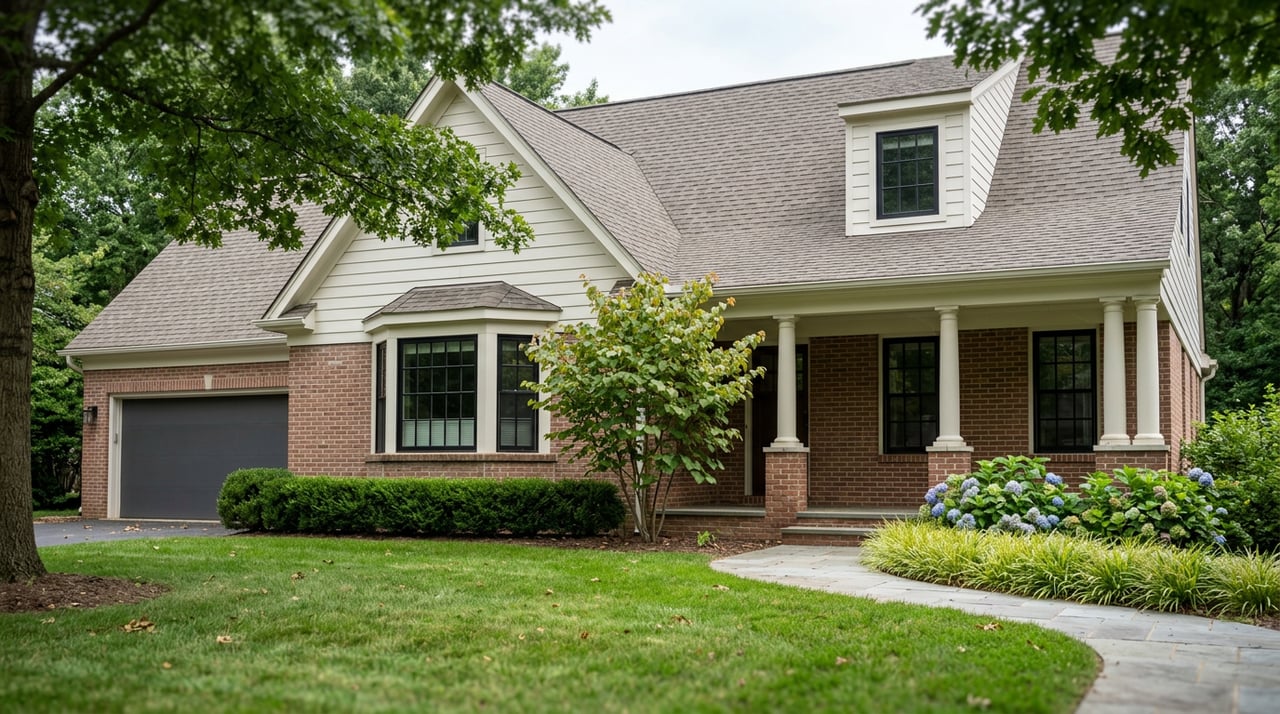
Vestavia Hills Doesn't Have One Housing Market Right Now. It Has Two.
September 3, 2026
As Vestavia Voice reported, City Manager Jeff Downes said, "If you went out there right now, you would see cranes."
The construction site is inside Liberty Park, where Medical Properties Trust is building its new headquarters, a project the city has called the largest commercial building, by value, ever built in Vestavia Hills. It sits inside The Bray, the 700-acre mixed-use development that is quietly splitting this city's housing market into two things that don't compare cleanly to each other.
If you've started pricing homes here, you've probably already bumped into the problem without knowing what caused it. Pull up three different sources and you'll get three different answers for what a home in Vestavia Hills actually costs.
Redfin puts the median sale price at $600,000 over the three months ending in May 2026, up 2.2% from the same stretch a year earlier, with homes typically selling in 35 days. Zillow's home value index, updated at the end of June 2026, lands lower, at $576,337, though it shows a faster year-over-year climb of 4.1%. A third source, Houzeo, reports a median in the high $530,000s and shows it moving in the opposite direction, down against the year before.
None of these sources is wrong exactly. Each is measuring a slightly different slice of the same city, and that's the point. When brand-new construction and thirty- and forty-year-old resale homes both get folded into a single "median," the number you see depends heavily on which homes happened to close during whatever window that source is counting.
In a city with a stable, uniform housing stock, that kind of spread would be a rounding error. In Vestavia Hills right now, it's a signal. A genuine second market is forming, and it's forming fast enough that the data providers can't quite agree on how to average it.
The Bray is the reason. Approved as a public-private partnership between the city and Daniel Corp, the development is slated to bring 1,800 residential units and a 100-acre town center, with retail, a hotel, restaurants, medical offices and green space, to what has been described as the last large undeveloped tract left inside Vestavia Hills. Medical Properties Trust's headquarters is the anchor tenant, moving the real estate investment company's operations out of downtown Birmingham and into Liberty Park.
The pace of the buildout since late 2025 has been hard to miss if you've been paying attention. In July 2026, the Compton family, longtime owners of Compton Ace Hardware in Crestline Park, closed on a one-acre lot inside The Bray off Collier Drive, across from the Medical Properties Trust site and next to the Publix-anchored Marketplace at The Bray. Their new store is planned to run 12,000 to 15,000 square feet, larger than their existing location, with construction targeted to start by the end of this year and an opening roughly 12 months out.
The restaurant scene inside The Bray has moved just as fast, arriving and adjusting in real time. Caffe di Roma opened in December 2025 in a space that had been a Papa Murphy's, run by the same owner behind Napoli Italian Restaurant & Pizza over in Rocky Ridge. Napoli itself closed for most of January 2026 due to staffing shortages before reopening that February, a reminder that even a hot corridor doesn't insulate a small operator from ordinary running-a-restaurant problems.
None of this investment is confined to The Bray, either. Elsewhere in the city, on the original Montgomery Highway corridor, a Mobile-based investment group called Burton Property Group closed on the purchase of Vestavia Hills City Center for $76 million earlier this year, a 390,000-square-foot, Publix-anchored property that's home to Taco Mama and Starbucks. It's the group's first acquisition in the Birmingham metro, and it tells you capital is betting on more than one part of this city at once, just not on the same kind of housing.
Growth this fast tends to outrun the infrastructure built to support it, and Vestavia Hills has a specific, current example of that. The city has been working on a sidewalk, drainage and widening project along Massey Road between Columbiana Road and U.S. 31, roughly 4,100 linear feet of new sidewalk plus a retaining wall and full resurfacing. The project hit a snag in spring 2025 when crews found an uncharted water main during construction, pushing the schedule back. As of the most recent reporting, the restart was targeted for around March 2026, with the city covering design costs through a 20% match and ALDOT administering the construction contract.
If you're comparing a listing near that stretch of road to one further away, that's worth a direct question to whoever is showing you the house. A construction delay on a nearby road isn't a dealbreaker, but it's exactly the kind of detail a median price will never tell you and a walk-through won't always reveal either.
None of this means Vestavia Hills is a bad place to buy right now. It means the city isn't one market to evaluate, it's two, and they behave differently.
A home inside The Bray is going to price against new construction: HOA structures built for a master-planned community, comps that are mostly other new builds, and a resale history that barely exists yet because the units haven't been around long enough to turn over. A home in an established section like Cahaba Heights, Rocky Ridge or Green Valley is going to price against decades of resale data, settled trees and yards, an HOA structure if there is one that was set up under very different assumptions, and a track record you can actually pull comps from.
Before you lock in on either side, a few direct questions are worth asking:
A single median price can't answer any of those. A local conversation can.
Does buying inside The Bray mean paying a premium for something unproven? Not necessarily, but you're paying new-construction pricing for a resale history that's still being written. That's a different kind of risk than buying a home with thirty years of comparable sales behind it, not automatically a worse one.
Will the Vestavia Hills City Center sale change anything for nearby homeowners? It's too early to say. A $76 million acquisition by an out-of-market investment group is worth watching, since new ownership can mean upgrades, redevelopment or simply steady management. For now it's a data point, not a verdict.
If you're trying to figure out which side of Vestavia Hills actually fits your budget and your timeline, that's the kind of comparison worth doing with someone watching both corridors day to day. Randy Aldrich has spent years walking buyers and sellers through exactly this kind of mixed market across Jefferson, Shelby, St. Clair and Blount counties. Let's Connect and talk through what a listing near The Bray, or one in an established section of Vestavia Hills, actually means for what you're buying.
Stay up to date on the latest real estate trends.
I am dedicated to providing exceptional service to my clients and helping them achieve their real estate goals. In my free time I enjoy staying active and engaged in the community.
1110 N Chalkville Mountain Rd #156,
Trussville , AL 35173